
Non-Surgical Spinal Decompression at Innate Chiropractic
Take Pressure Off Your Spine—and Get Back to the Life Pain Has Taken From You
You have tried resting.
Stretching.
Pain medication.
Maybe chiropractic care, physical therapy, injections, or simply hoping the problem would eventually disappear.
But the back pain keeps returning.
The numbness still travels down your leg.
Sitting, standing, sleeping, working, and exercising are harder than they should be.
When irritated discs and spinal joints are placed under constant pressure, your body may struggle to recover. Non-surgical spinal decompression is designed to gently reduce that pressure and create a better environment for healing.
No surgery.
No injections.
No medication.
No hospital stay.
Just a comfortable, customized treatment designed to help you move better, hurt less, and return to the activities you enjoy.

What Is Non-Surgical Spinal Decompression?
Non-surgical spinal decompression is a computerized form of motorized traction that gently stretches and relaxes specific areas of the spine.
During treatment, carefully controlled pulling forces are applied in a series of gradual cycles.
The goal is to:
✔ Reduce mechanical pressure on irritated spinal structures
✔ Improve movement between spinal segments
✔ Relieve pressure affecting sensitive nerves
✔ Promote circulation around discs and surrounding tissues
✔ Create a more favorable environment for recovery
Unlike surgery, nothing is cut, injected, or removed.
You remain fully clothed and comfortably positioned while the treatment is customized to your condition, comfort level, and goals.
Your Back May Not Need More Force.
It May Need Less Pressure.
The discs between your spinal bones act as cushions.
They help absorb force, support movement, and create space for nerves to exit the spine.
Over time, repetitive stress, injuries, prolonged sitting, poor mechanics, degeneration, or sudden trauma can place excessive pressure on these structures.
That pressure may contribute to:
- Disc bulges
- Herniated discs
- Irritated spinal joints
- Muscle guarding
- Reduced mobility
- Nerve irritation
- Pain traveling into the arms or legs
When the spine remains compressed, even simple activities can continue aggravating the area.
Decompression therapy gently separates targeted spinal segments, helping temporarily reduce pressure and improve movement without aggressively forcing the spine.

What Does Spinal Decompression Help Accomplish?
The purpose of care is not simply to make the treatment table feel good.
The goal is to help you experience meaningful improvements in everyday life.
Patients may seek decompression therapy to help them:
- Sit more comfortably
- Stand or walk longer
- Sleep with less discomfort
- Reduce pain traveling into an arm or leg
- Improve spinal mobility
- Return to work or exercise
- Decrease reliance on temporary symptom-management strategies
- Avoid or delay more invasive procedures when clinically appropriate
Research involving patients with lumbar disc herniations has reported improvements in pain, leg symptoms, and disability following non-surgical decompression or motorized traction programs. However, results vary, and decompression has not consistently been shown to outperform every other form of traction or rehabilitation.
Conditions That May Respond to Spinal Decompression

Herniated or Bulging Discs
A disc herniation occurs when the softer internal material of a spinal disc pushes through or irritates its outer layers.
Depending on its location, this may cause:
- Local back or neck pain
- Muscle spasms
- Numbness
- Tingling
- Weakness
- Pain traveling into an arm or leg
Decompression therapy may help reduce mechanical irritation and support a more comfortable healing environment.
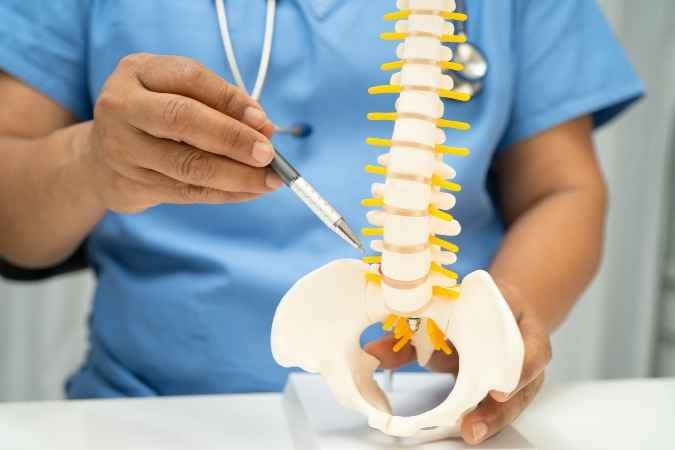
Sciatica
Sciatica commonly describes pain that travels from the lower back or buttock into the leg.
It may feel like:
- Burning
- Shooting pain
- Electric sensations
- Numbness
- Tingling
- Leg weakness
When sciatica is associated with a compressed or irritated lumbar nerve, reducing pressure around the affected spinal area may help improve symptoms.
In a randomized study involving patients with lumbar disc herniation, the decompression group demonstrated lower leg-pain scores and better disability scores at portions of the follow-up period than the sham-treatment group.

Degenerative Disc Changes
Spinal discs naturally change with age.
For some people, these changes are painless. For others, reduced disc height, stiffness, and joint stress may contribute to ongoing discomfort.
Decompression therapy cannot reverse every age-related change, but it may help reduce pressure, improve mobility, and make movement more comfortable.

Chronic Low Back Pain
Back pain often becomes chronic when multiple factors remain present, including:
- Restricted spinal movement
- Muscle guarding
- Disc irritation
- Joint stress
- Poor movement patterns
- Deconditioning
- Repetitive strain
Spinal decompression may be included as one part of a broader care plan addressing both symptom relief and the factors contributing to the problem.

Facet Joint Irritation
Facet joints guide spinal movement.
When these joints become compressed or irritated, they may cause:
- Localized back or neck pain
- Stiffness
- Pain when extending or rotating
- Pain after prolonged standing
Gentle decompression may temporarily reduce pressure across these joints and make movement more comfortable.

Neck Pain and Arm Symptoms
When cervical discs or joints irritate nearby nerves, symptoms may travel into the:
- Shoulder
- Arm
- Elbow
- Hand
- Fingers
Depending on the diagnosis, cervical decompression may be used to reduce pressure and complement chiropractic care, rehabilitation, and corrective exercise.
Have You Been Told to “Just Live With It”?
Chronic spinal pain can slowly shrink your life.
You stop exercising because it hurts.
You avoid long drives.
You cannot sit through a meeting comfortably.
You hesitate to pick up your children or grandchildren.
You begin organizing your day around what your back might tolerate.
Eventually, the problem is no longer just pain.
It is lost freedom.
Spinal decompression gives appropriate patients a conservative option before immediately turning to injections or surgery.
It is not right for every condition, and it is not a guaranteed replacement for necessary medical care. But for qualified patients, it may be an important part of a non-surgical recovery plan.
How Spinal Decompression Works
1. You Are Comfortably Positioned
You remain clothed and lie on the decompression table while a supportive harness is positioned around the treatment area.
2. Your Treatment Is Customized
Your provider selects the appropriate:
- Treatment area
- Pulling force
- Angle
- Duration
- Progression
The settings are based on your examination findings, diagnosis, symptoms, size, and tolerance.
3. Gentle Cycles Reduce Spinal Pressure
The table gradually alternates between tension and relaxation.
These controlled cycles are intended to stretch targeted spinal tissues without causing the muscles to strongly guard against the movement.
4. Your Body Responds Over Time
As care progresses, the goals may include:
- Reduced nerve irritation
- Improved spinal movement
- Less muscle guarding
- Improved tolerance for daily activities
- Better participation in rehabilitation exercises
Decompression is often most effective when combined with care that improves strength, stability, mobility, and movement habits.
What Does Treatment Feel Like?
Most patients describe decompression therapy as:
- Gentle
- Comfortable
- Relaxing
- A gradual stretching sensation
Many patients feel less pressure during or immediately after a session.
Some people experience temporary soreness as their bodies adapt, especially when beginning care. Treatment intensity can be adjusted based on your response.
A typical session may last approximately 15–30 minutes, depending on the area treated and your individual care plan.

How Many Treatments Will I Need?
There is no universal treatment schedule for every patient.
The recommended number of sessions depends on:
- Your diagnosis
- How long symptoms have been present
- The severity of the condition
- Whether nerve symptoms are present
- Your response to early sessions
- Your activity level
- Your overall treatment plan
Research protocols have varied considerably. Some studies have used approximately 10 sessions over eight weeks, while others have used 15–20 sessions over several weeks.
Your provider will recommend a plan based on your examination rather than using the same protocol for every patient.
Why Decompression Should Not Be Used Alone
Taking pressure off an irritated area may help you feel better.
But lasting results usually require more than lying on a table.
If poor movement, weakness, repetitive strain, or instability contributed to the problem, those factors should also be addressed.
Your care plan may include:
Chiropractic adjustments
Spinal decompression
Corrective exercises
Core and spinal stabilization
Mobility work
Postural recommendations
Activity modifications
Recovery strategies
Decompression creates an opportunity.
Your personalized care plan helps your body use that opportunity.
Spinal Decompression and Chiropractic Care
These services perform different but complementary jobs.

Chiropractic Care
Chiropractic adjustments are used to improve joint motion, spinal function, and nervous-system communication.

Spinal Decompression
Decompression applies sustained, controlled traction to reduce pressure and gently stretch targeted spinal tissues.
Together, they may help:
- Improve mobility
- Reduce mechanical stress
- Calm irritated nerves
- Decrease muscle guarding
- Support better movement
- Make corrective exercise more comfortable
The combination used will depend on your examination and diagnosis.
Why Patients Consider Decompression Before Invasive Care
When back or neck pain does not improve, patients may feel that their only remaining choices are injections or surgery.
That is not always the case.
Depending on the condition, a conservative progression may include:
Activity Modification
↓
Chiropractic and Rehabilitation
↓
Non-Surgical Spinal Decompression
↓
Injections or Specialist Evaluation
↓
Surgery When Medically Necessary
Spinal decompression does not eliminate the need for surgery in every case.
It provides an additional conservative option for appropriate patients who want to explore non-invasive care first.

Frequently Asked Questions
Is Spinal Decompression the Same as an Adjustment?
No.
An adjustment is a controlled movement applied to a joint.
Spinal decompression uses gradual, sustained pulling forces to gently stretch a targeted region of the spine.
Some patients receive both as part of their care plan.
Is Spinal Decompression Painful?
It should not be sharply painful.
Most people describe a comfortable stretching or pressure-relieving sensation. Your settings can be modified at any point based on comfort and clinical response.
Is This the Same as Hanging Upside Down?
No.
Inversion uses gravity and generally applies a less precise pulling force across a broad portion of the body.
Computerized decompression allows the provider to control the force, angle, duration, and treatment region more specifically.
Will It Put My Disc Back Into Place?
Claims that decompression simply “sucks a disc back in” are an oversimplification.
Some imaging studies have reported reductions in herniation measurements after conservative care, but decompression has not consistently demonstrated a unique ability to physically reverse disc herniations compared with other rehabilitation approaches.
Its more practical goals are reducing symptoms, improving function, and helping patients participate in recovery.
How Quickly Will I Feel Better?
Some patients experience relief within the first few sessions.
Others improve gradually over several weeks.
Chronic or severe conditions generally require more time than mild, recent problems.
Your progress will be monitored throughout care.
Can I Exercise During Treatment?
Usually, yes—but your exercise program may need to be modified.
The goal is not to avoid movement indefinitely. The goal is to identify movements that support healing while temporarily limiting activities that repeatedly aggravate the condition.
Is Decompression Safe?
Non-surgical spinal decompression is generally considered a conservative treatment when properly prescribed and administered.
However, it is not appropriate for everyone.
A thorough history and examination are necessary before beginning care.
Who May Not Be a Candidate?
Spinal decompression may be inappropriate or require medical clearance in people with certain conditions, including:
- Recent spinal fracture
- Severe osteoporosis
- Spinal instability
- Certain spinal tumors or infections
- Abdominal aortic aneurysm
- Conditions requiring urgent surgical evaluation
- Some implanted spinal hardware
- Advanced neurological deficits
- Pregnancy, depending on the treatment region and positioning
This is why every patient should be evaluated before treatment begins.
When Back Pain Requires Immediate Medical Attention
Seek urgent medical evaluation if back or neck pain is accompanied by:
New loss of bladder or bowel control
Numbness in the groin or saddle region
Rapidly worsening weakness
Significant trauma
Fever with severe spinal pain
Unexplained weight loss
Progressive loss of coordination
Symptoms suggesting a stroke or other emergency
Spinal decompression is not a substitute for emergency or medically necessary care.
Why Innate Chiropractic?
We do not believe every patient needs the same treatment.
And we do not believe chronic pain should be managed with temporary solutions forever.
At Innate Chiropractic, we evaluate how your spine moves, how your nervous system is functioning, what aggravates your symptoms, and what may be preventing your body from recovering.
Then we create a personalized plan designed to help you:
Move better.
Feel stronger.
Reduce pain.
Restore confidence in your body.
And return to the activities that matter
Stop Letting Back Pain Make Your Decisions
Pain should not determine:
Where you go.
How long you sit.
Whether you exercise.
How you sleep.
Whether you pick up your child.
Or how much of life you are able to enjoy.
You may have more options than you realize.
Book Your Spinal Decompression Appointment Today
We will evaluate your condition, determine whether decompression is appropriate, and build a personalized plan around your goals.